Showing posts with label fantasy. Show all posts

Friday, January 25, 2008

Here Be Dragons, or Be Careful What You Drink

Plus Musings on Twitter and the Language of Birds

There is an old Norse legend, perhaps best known through Wagner’s opera Siegfried, that he who drinks the blood of dragons will be gifted with the ability to understand the language of birds. In that legend, Sigurd (or Siegfried) slays the dragon Fafnir and then either bathes in and takes a celebratory chug-a-lug of his enemy’s blood or just accidently gets some blood in his mouth, depending on what folkloric version you favor. Either way, Sigurd doesn’t learn any pithy lessons about being careful what you put in your mouth, because he mostly gets a lot of helpful oracular advice from his feathered friends.

That said and Niebelung legends aside, perhaps my favorite representation of the dragon’s blood legend appears in Newbery Honor author Nancy Farmer’s wonderful blend of historical fiction and myth-inspired adventure, The Sea of Trolls, in which young Saxon Jack and his Viking captors encounter dragons, trolls, giant spiders, and more, when they embark on a series of adventures rooted in Norse legend. In Farmer’s representation, Viking berserker-initiate Jill becomes infected with dragon’s blood and discovers it’s a bit more of a mixed blessing than the story of Sigurd suggests. She learns that while the avian population might chirp up some good gossip, such as whether your enemies are massing over the next hill, mostly they just do a lot of what my dad used to call nattering and gromishing. That is to say, they talk a lot about very little.

So where am I headed with this? Well, Farmer’s musings on dragon’s blood and the language of birds provide as good a metaphor as any for the infamous social networking and micro-blogging service Twitter, currently under exploration for its value in the world of libraries.

While I see a certain potential value in Twitter as an up-to-the minute communication tool for far-flung and “virtual” work teams (virtual, that is, in the sense of teams working together in an online or virtual environment such as email, blogging, or twittering), Twitter can also represent a time and productivity drain for workplaces and a hotbed for missing and missed communications if not used properly or if too heavily or inappropriately relied upon as a communication tool. Still, keeping that concern in mind, there can be some big pluses for team Twittering. Just by way of example, while I was logged onto Twitter for krl2pt0 purposes I observed KRL Training Coordinator Bob Christensen’s of-the-moment update that he had posted new materials on the krl2pt0 site. Hmmm. Imagine if I were working on a time-sensitive project and looking for input from teammates. The entire work team could be instantly directed to Bob’s input and ideas even as he produced them. So… In a nutshell, Twitter strikes me as best designed for time-sensitive virtual team projects and committees. As far as the social aspect of Twitter goes, look no further than the metaphor of the birds to see what I think and whether I will use it that way.

Here Be Some Real Dragons: Bitterwood, by James Maxey
On a dragon-related note, I recently finished an outstanding new entry in the dragon/fantasy/science fiction genre, Bitterwood, by genre newcomer James Maxey. Read my brief review here. Call me a sucker for well-crafted words, but I am a big fan of the dragons of J.R.R. Tolkien’s The Hobbit and Ursula K. LeGuin’s A Wizard of Earthsea, who are both fascinated by and distracted by a little well-honed argument—well, at least in the Aristophanic sense.* Maxey’s articulate, sometimes contemplative, and often rhetorically-driven dragons—particularly the ultra-evil “murder god” Blasphet—fit the bill perfectly. Then again, if you're like my husband and you prefer your dragons to stick with pillaging and carnage, Maxey offers a healthy portion of that, too. Maxey's slow unfolding of remnants of misunderstood and forgotten technology in a post-apocalyptic future landscape will also attract fans of Gene Wolfe’s Book of the New Sun and Book of the Long Sun, even as they remind us of the Arthur C. Clarke maxim that “Any sufficiently advanced technology is indistinguishable from magic.” (Starred review in Publishers Weekly and Booklist.)

*In his comedy Clouds, Aristophanes posits a Socratic School where young Greek youths learn rhetoric to argue the Wrong Argument and defeat the Right Argument. His characters attend this school to learn to argue their debts away, and comic mayhem ensues. My Point? Dragons, like Aristophanes' students in Clouds, are known to value argument for the sake of argument and as a means to justify questionable (often monetary) ends.

Wednesday, October 17, 2007

Mmmmm deee-licious

Titillate your tastebuds with reading... and social bookmarking?

Good food and good books shared with good friends—those things form a big part of my life. This week, besides sharing a few good books, I want to share a delicious new way to learn, grow, and share one's interests, whatever they may be. You guessed it, I'm talking about del.icio.us. Del.icio.us is a Web-based social bookmarking site that makes it easy for users to move from site to site while always returning with one click to his or her list of favorites. Not only that, del.icio.us provides new opportunities for readers (or Web surfers) to network with other readers (and surfers) with similar interests.

For example, fans of C. S. Lewis might wish to tag Lewis’s unofficial Web site Into the Wardrobe. Once you’ve tagged the site, you will not only find that 172 other people have tagged the site, you will be able to view other sites those 172 people have tagged that may also be of interest to you. [Disclaimer: naturally, you don’t know those people or how reputable or appropriate for your purposes their favorites may be. You should still always be diligent in checking the reliability of any source, especially any internet source, before singing its praises.]

Now, speaking of C.S. Lewis and all things delicious... Lewis once said that if you wanted to interest children in reading, you should write about things that interest children—things like, for example, food. Perhaps that's why we find so much eating in the world of Narnia—from sumptuous afternoon teas with fauns to fresh fish feasts with Mr. and Mrs. Beaver to turkish delight with, well, let's just say someone who proves in one gesture why children should never accept candy from strangers.

Lewis also offered some pretty delectable fare for the grown-up palate with his classic Garden of Eden allegory, Perelandra, set on the watery world of Venus. Written in the 1940s, the science may be dated, but the story is timeless—and you'll never forget Lewis' description of the Perelandran gourds, that are neither sharp nor sweet, neither savory nor voluptuous.

In any case, if you want to create a world to delight your readers, one where they may immerse themselves as one of the natives, there is no better way than though the cuisine. Here are just a few of my favorite visual and literary feasts that touch on the power of sharing a meal, a recipe, or a culinary custom:

Kitchen, by Banana Yoshimoto
Like Water for Chocolate, by Laura Esquivel
Neveryona, by Samuel R. Delany
Babette’s Feast (movie)

Please share your literary feasts with me, and if you find good sources for more, don’t forget to tag them and then share your tags with me!

More of a dinner-and-a-movie type? Don't forget to check out 000h How I Loved That Movie for plenty of film, food, and fun.

Friday, October 12, 2007

Comfort Books


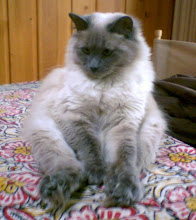
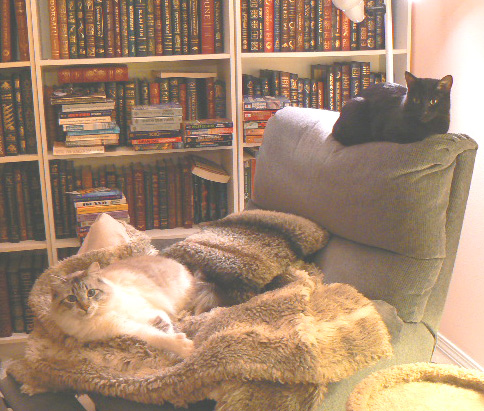
I'm a big believer in pet therapy, comfort food, and of course comfort books. But before we go there, take a moment to slide your eyes to the right and feast them on the love-bunny known as Rho. Rho is Megzilla's brother, and a little less precociously brainy than his sister. He is, however, quite a sweetheart, loves to give hugs and kisses. So take a deep breath, gaze long into those melting blue eyes, and feel yourself to be deeply loved. Aahhhh, feels good, doesn't it?

Now that the pet-lovers have all forsaken their computers to go hug their own feline and canine family members, let's get back to the subject of comfort books. You know the ones I mean: the ones that you always come back to, the books that never fail to give solace on the coldest, wettest, worst-ever days, the days when you lock your keys in the car, argue with your spouse, slip in a mud puddle, and have to eat leftover tuna cassarole for lunch when you absolutely loathe tuna cassarole. On days like that, my husband likes to immerse himself in the world of Anne Bishop's Black Jewels Trilogy. I haven't read it yet, but if you have you might want to log in here and let me know what kind of oddball I'm married to, since the reviews all use words like dark, disburbing, and violent, strangely counterpointed with other words like romantic, witty, teasing, and--strangest of all if you knew my husband--matriarchal. Having said that, I'm thinking my husband may be a little like Meggy and there's some freakin' serious stuff going on behind that innocent blue-eyed gaze.

Back to comfort books. One of my favorite comfort reads is Little Women, a choice which no doubt many of you will understand instantly and wholeheartedly. I honestly have never met the person who grew up American, female, and reading who did not love this book. It's a classic for a reason.

Another favorite comfort book is the aforementioned The Hitchhiker's Guide to the Galaxy. What can I say? It's not enough to know that Vogon poetry is the third worst in the galaxy, Douglas Adams does not scruple to tell you what out there may be worse. If you read this and don't laugh, I am very, very sorry.