Showing posts with label gothic novels. Show all posts

Thursday, March 13, 2008

What is Goth? Just ask at the library...


Ask not what you can't learn at the library... That would be a really short conversation. Ask what you CAN learn. The list will be endless.

Just to dispel any question: the above slide show does feature a photo of one of those rare but wonderful Suburban Goth Librarians, the kind usually found perusing the industry reviews to make sure the library holds a rich, varied, up-to-the-moment book collection. (Hint: The Librarian is the one in black.) The rest of this scurvey lot of Medieval, Perky, Punkesque, and Wizardly Goths are not librarians but do in fact work in a library—ironically, a bright sunny library with comfy chairs, cheerful decor, a friendly engaging staff, and lots of wonderful, exciting programs and events for the whole community.

One day this cast of misfits decided to illustrate—by moping, dressing in black, painting weird curlicues around their eyes, and changing their names to things like Funeralisa, Tishella, Kali-Ma and Constantina the Dark—just how many things can be learned in a library. Yes, that's right. We—for I am one of them—became Goth for a day. (OK, for some of us, it's not that much of a stretch.) Want to learn more about the whole Goth thing? Check out our reading list:

Paint It Black: A Guide to Gothic Homemaking, by Voltaire (yes, crafts ARE involved)
The Goth Bible, by Nancy Kilpatrick
Goth Chic: A Connoisseur's Guide to Dark Culture, by Gavin Baddeley
Everything You Need to Know About the Goth Scene, by Kerry Acker
Goth craft : the magickal side of dark culture, by Raven Digitalis

On a related note: For a peek at the fusion of Goth culture and "Lolita" fashion in Japan, check out the startling photographs and funky design of Gothic and Lolita, by Masayuki Yoshinaga and Katsuhiko Ishikawa. Similarly, Gothic & Lolita Bible, Vol. 1, combines for the first time in the US four volumes of the Japanese mook (part fashion magazine/part book), Gothic & Lolita Bible. I haven't seen it yet, but I can't wait.

You might also want to read one of the earliest Gothic novels (Gothic novels are a must for all serious Goths), currently available in the KRL collection, The Castle of Otranto, by Horace Walpole. (Yes, dedicated Jane Austen fans, this is one of the works that Jane flogs so mercilessly in Northanger Abbey.) Other must-read fiction for Goths:

Oh My Goth! Version 2.0, by Voltaire
Dracula, by Bram Stoker
Tales of H.P. Lovecraft
Rebecca, by Daphne Du Maurier
Pretty much anything by Anne Rice

Not enough for you? Feel free to sulk about it.

Either that, or send me your Goth favorites. Meanwhile, prepare for your own Goth day by learning How to be Goth in seven easy steps. Until then, have a dark and miserable day.

Sincerely, Constantina Countess of the Dark

Wednesday, October 31, 2007

Trick or Treat? A blogful of literary goodies to celebrate the season

Happy Halloween and time for one last wave of the pointy witch’s hat (between Trick-or-Treaters) to all those seasonal favorites—hauntings and spirits and witches, oh my! One of my favorite books with a splendidly mist-shrouded All Hallow’s feel is John Harwood’s wonderfully gothic exploration of the traditional ghost story in The Ghost Writer. The Ghost Writer is a gorgeous puzzle box of intertwining tales, all connected by an overarching mystery in which timid librarian Gerard seeks answers to his inscrutable pen pal's strange past and his own family's somewhat shady history through a series of odd Victorian manuscripts—ghost stories, of course. The manuscripts, each one a perfectly formulated exercise in gothic style, provide clues to the mysteries in Gerard’s life, but will they help him in time to save him from his family’s ghosts? Read it and see.

For a complete change of pace, check out my absolute favorite book about witches, Lolly Willowes, or The Loving Huntsman, by Sylvia Townsend Warner. A full eighty years before Harry Potter, poet Warner penned this rather charming country novel about timid Edwardian spinster, Laura (a.k.a. Lolly) Willowes, who shakes off the conventions of her day to become a witch. Harry Potter fans beware—there really isn’t much magic practiced in this one. Published in 1926, the pace is leisurely, the writing precise and poetic, but—witchcraft aside—the real thrust of the novel is its highly unconventional celebration of freedom from social constraints that, in those days, often relegated women of Lolly’s station to unpaid household laborers. Fans of Barbara Pym's writing might also enjoy this salute—with a little spin of its own—to the excellent women of a bygone era.

Thursday, October 25, 2007

Straight from the Witch's Cauldron: Victorian Ghost Soup

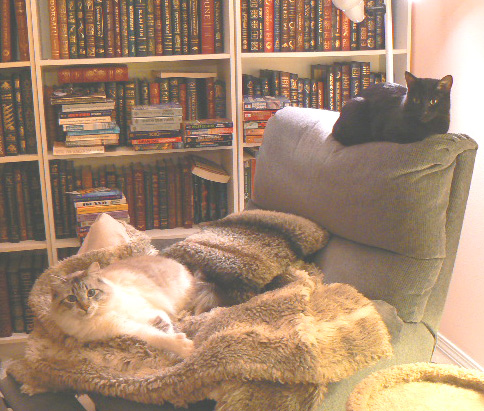
Mist mantled mornings. Check. Skittering leaves that flutter and carpet our rain-damp paths. Check. Bare bones of trees (check) that rattle against the silent backdrop of an eerie harvest moon. Check. Freak windstorms, hailstorms, and lightening strikes that rattle the library windows. Check, check, and check. You guessed it, it must be Halloween, and what better time than a fog-shrouded fall evening with the rain tapping a ghostly coda on the darkened pane—what better to time, I say, than to cuddle up on the sofa with a cup of cocoa, a pair of cats (black of course), and a good book.

Since the season demands, I find myself wondering why it is that the words Victorian and ghost story seem to belong together like macaroni belongs with cheese. Maybe we just have Henry James and The Turn of the Screw to thank for this, or maybe repression and catharsis are another natural pairing that naturally manifests as a spectral blue emanation in the back parlor amongst the roll top desks and hand-painted fans. Whatever the case, we can thank Egyptologist author Arthur Phillips for another shall-we-say interesting and worthy entry in the Victorian Ghost genre with his recent novel Angelica.

Set in 1880s London, Angelica details a family’s downward spiral as a mysterious nocturnal spirit begins to haunt their lives, shattering their peace, disrupting their marriage, and possibly even threatening their child’s life. But is the specter real or is it imagined? Told from the point of view of four disparate family members, the story unfolds as a strange tale of denials, half-truths, buried secrets, and hidden motives, strongly in the vein of a Victorian-style Rashomon. In that respect, readers of the author’s other novels (Prague, The Egyptologist) will recognize Phillips’ trademark ambivalence toward his characters, whose self-deceptions form a unique pathos that is hard to resist. Psychologically complex and rich in atmospheric detail, Angelica is a delectible potage of themes and motifs, part psychoanalysis, part Victorian ghost story, part childhood memory—and entirely impossible to put down. So bring on the fuzzy slippers and the mini-marshmallows, Angelica is a perfect Fall read.